Showing posts with label Development in Social Media. Show all posts

Tuesday, 15 November 2011

Launch of First iPad-Only News Application Raises Concerns for Traditional Publications

On February 2nd 2011, Rupert Murdoch launched the new iPad-only newspaper application that serves to provide daily coverage of news designed only for the iPad. The following application brings groundbreaking technology innovations to a new level as it provides users with instant updates of news, Twitter feeds related to the following news selected and the latest occurrences all for a cheaper price. As different pioneering innovations for publications as such are being made more, there is a growing concern that the use of traditional tabloids and newspapers are declining, especially in the use of the younger generation.


 (Source: TechedOn, www.techedon.com)

In such a fast moving era like ours, technology will continue to develop. And with these forms of development, education is changing and societies are improving. According to Kress & van Leeuwan (2006), modes symbolizing meanings will continue to change throughout time and meaning-makings conveyed semantically can expand into distinctive aspects of social practice. Therefore, in my opinion, human behavior towards technological aspects such as digital news publications should be accepted and adapted by societies of today.

The numbers of people who live in modernized cultures using smart phones are constantly increasing. An example of another revolutionary article would be the Evernote application for iOS technology. 


(Source: Evernote, www.evernote.com)

Very much like Murdoch’s application, Evernote serves a new purpose in another aspect, which is note taking. The application provides a convenient way for users to note down their ideas, easy interacting with colleagues and productive ways to plan schedules that can be easily synced and accessed from their devices (Evernote 2011). The cutting-edge application in a way revolutionizes the way people can take notes of details, whether or not in class or at work and might bring an end to traditional writing of notes soon.
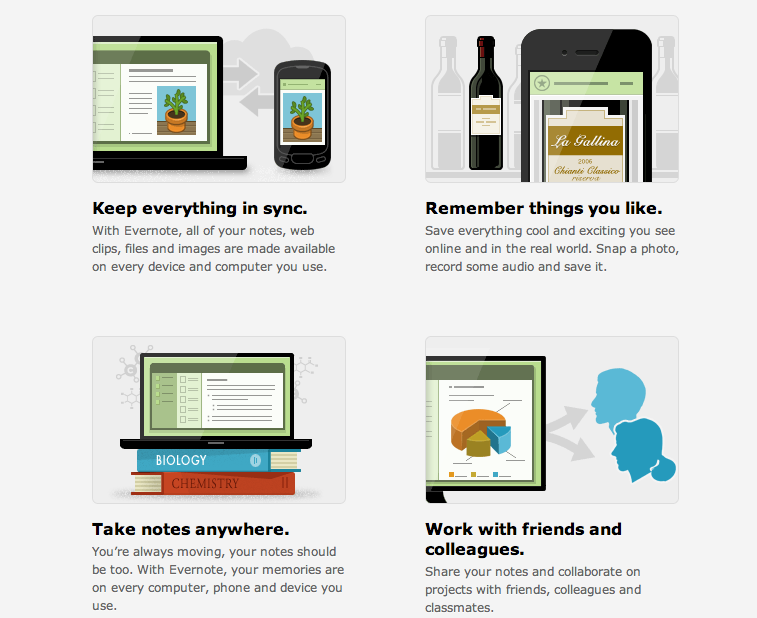
(Source: Evernote, www.evernote.com)
According to Walsh (2006, p.33), interpretation between readers and texts are a two-way interaction and thus, forms of which we interpret new texts can create new aspects of implications. In the field of design and publication, multimodal texts are currently turning into the regular patterns of society and therefore, our conceptual framework to understand them has to incorporate new ways of mode processing knowledge (Walsh 2006, p36).
References
  • Kress, G & Leeuwan, V 2006, Reading Images: The Grammar Of Visual Design, 2nd edn, Routledge, New York.
  • Walsh, M 2006, The 'textual shift': Examining the reading process with print, visual and multimodal text, Australian Journal of Language and Literacy, p.33-36.
  • 2011, Take Note of Everything, Evernote, viewed 13 November, <http://www.evernote.com/about/learn_more/>.
  • 2011, THE WORLD AS A LEARNING ENVIRONMENT, University of Amsterdam, viewed 13 November 2011, <http://www.mobieleonderwijsdiensten.nl/attachments/1765201/World_as_learningenvironment.pdf>.


Thursday, 25 August 2011

Screen vs. Print Document Design

Readers of documents these days choose a very direct approach in reading as most of them might not, in some cases, read from start to end. According to Hilligoss (2002), most readers currently prefer to scan as a tool to complete their thoughts for relevant findings.
According to Nielson (1999), three out of the six steps in differentiating print and screen/web designs, such as:
1.)   Dimensionality
2.)   Multimedia and Interactivity
3.)   Navigation
As stated by Nielson (1999) print media is made up of 2-dimensional layouts, which makes it achievable for people to turn tangible pages.

(Source: Google Images, 4freephotos.com)


On the other hand, screen designs are a 1-dimensional layout where readers get to experience scrolling between different pages by just a click or a drag of their mouse.

(Source: Google Images, Downloadstock.net)
As for multimedia and interactivity, screen media would benefit more than print media in a sense of user engagement. Although print media can contain pictures that give influence to a reader, screen or web media allows readers to provide their comments on the following subject, news or issue (Nielson 1999). This provides readers with audience interaction where practical feedback can also be obtained.

(Source: Google Images, gettingtoyesfaster.com)
Lastly, in terms of navigation, print media’s feature is simple page turning, where readers benefit with a simple printed outline. As for online media, it benefits readers with its convenient and specific navigation through websites.
Although online media represents a better medium to some comparing to print, it does not mean that print media is no longer required; it represents an essential tool of communication despite its traditional features. In my opinion, I believe both mediums are beneficial in their own way and are crucial in the world of communication.

References
  • Holligoss, S 2002, Visual Communication: A Writer’s Guide, Clemson University, viewed 24 August 2011, <http://www.ablongman.com/mycomplab_content/pdf/long_hilligoss.pdf>.
  • Nielson, J 1999, Differences Between Print and Web Design, Useit.com, viewed 24 August 2011, <http://www.useit.com/alertbox/990124.html>.

New Forms of Media Publishing

As stated in my second blog post, the usage of blogging continues to explode in growth. As stated by Kress and van Leeuwen (2006, p.36), new understandings are brought about in the semiotical landscape due to the modernization, multiculturalism, technology and communication in media. Thus, the modes of social media will continue to expand. Day-by-day, new forms of communication mediums in the social network are emerging.


(Source: O’Neill, n.d., makeuseof.com)

In the words of micro-blogging, an example of a breakthrough platform would be Twitter. According to O’Neill (n.d.), Twitter represents a social platform that allows users to write and broadcast short messages to their followers.

Although it seems more like sending a mobile text, Twitter is known for its unique benefits to bloggers and the media. Firstly, it serves as a medium that provides news where many media outlets have their own authentic account which functions as an online newspaper. 


(Source: Twitter.com, 2011)

Secondly, bloggers are able to support their blogs by using Twitter’s website called ‘Twitter Feed’. By the use of this, bloggers are able to ‘tweet’ their posts automatically through Twitter where it serves as an efficient method of promoting their webpages (O’Neill, n.d.).

Lastly, Twitter also provides credible methods of clarification. Most organizations and brands use Twitter as a medium to communicate and interact with consumers. This certainly shows its benefits towards the industry of Public Relations.


(Source: Twitter.com, 2011)

According to Naughton (2006), the unique and multifaceted modes of the relationship between online media and traditional journalism will develop to be beneficial to each other. In such a fast-moving era we all live in, the effects of these two powerful mediums are already starting to complement each other. 


References

  • Kress, G & Leeuwan, V 2006, Reading Images: The Grammar Of Visual Design, Routledge, New York.
  • O’Neill, M n.d., The Complete Guide to Twitter, Makeuseof.com, viewed 24 August 2011, <http://docs.google.com/viewer?a=v&q=cache:kf9YILoM5r4J:manuals.makeuseof.com.s3.amazonaws.com/twitter-guide.pdf+twitter+pdf&hl=en&gl=my&pid=bl&srcid=ADGEESiMKa92dpj5vnBDHl43ercpzos_Lva6g2ULzogBnMpPzUHWSPTCGELT04Rj_oxIRusOs8hiXyHNAbwyySysV20X2w_mPCpcx2BJnU-CBaUjfJSJ0J7EN5rJoP6F8DYWRdrALwfL&sig=AHIEtbSAWRW15Rf9sxJBsf0LE5O_gKfg1g>.
  • Jantsch, J 2009, Using Twitter for Business, Duct Tape Marketing, viewed 24 August 2011, <http://www.johnjantsch.com/TwitterforBusiness.pdf>.
  • Naughton, J 2006, Blogging and the emerging media ecosystem, Reuters Institute, viewed 24 August 2011, <http://reutersinstitute.politics.ox.ac.uk/fileadmin/documents/discussion/blogging.pdf>.


Blogs as a Current Phenomenon & Benefits of Blogging to The Community

The current situation of the blogosphere in the year 2010 has taken the next step forward in expanding with the influence of various social media tools (Soble 2010). Maven (2006) stated that the number of bloggers multiply by two times in every six and a half months.

A vital component in the trend is the expansion of the use of mobile blogging. According to Soble (2010), 25% of the blogosphere this year engages in blogging through smartphones and tablets. The emergences of micro-blogging websites have grown to be significant in the blogging community.

The graph below by Jalichandra (2010) displays the why bloggers practice micro-blogging:


(Source: Technorati Media, 2010)

Micro-blogging, such as Twitter or Facebook has moved towards a more beneficial phase from just social networking websites. According to Jalichandra (2010), a survey of 7,200 bloggers conducted by Technorati provided results that Twitter is being used by 73% of people whom blog for hobby and 88% of career bloggers.

In Malaysia, a country with little freedom of expression, the trend of blogging widely serves as a democratic medium for writers to have political discussion (Sandra  n.d.). It can be a place for dissent and a substitute source for news. Whereas in India, most of the blogger community prefer reading blogs that provide information about technology (Dikshit 2006). Therefore, there are many uses for blogging.
Conclusively, in an emerging technological era, journalists and established media houses will continue in producing content. But the massive development in blogging will continue to grow and soon might bring an end to traditional writing.


References
  • Soble, J 2010, State of the Blogosphere 2010 Introduction, Technorati, viewed 23 August 2011, <http://technorati.com/blogging/article/state-of-the-blogosphere-2010-introduction/#ixzz1VwRZkgyg>.
  • Jalichandra, R 2010, 2010 | STATE OF THE BLOGOSPHERE, Technorati Media, viewed 23 August 2011, <http://techcrunch.com/2010/11/03/state-blogosphere-2010-slides/>.
  • Sandra, S n.d., Blogging in Malaysia: Hope for a New Democratic Technology?, Faculty of Information and Media Studies, University of Western Ontario, viewed 23 August 2011, <http://www.cprsouth.org/wp-content/uploads/drupal/Sandra_Smeltzer.pdf>.
  • Dikshit, S 2006, Interesting blogging trends in India revealed in new survey, The Hindu, viewed 23 August 2011, <http://hindu.com/2006/11/28/stories/2006112800452200.htm>.
  • Maven, R 2006, Blogosphere doubling in size every six months, Econsultancy, viewed 23 August 2011, <http://econsultancy.com/us/blog/150-blogosphere-doubling-in-size-every-six-months>.