Showing posts with label New Forms of Media Publishing. Show all posts

Tuesday, 15 November 2011

Launch of First iPad-Only News Application Raises Concerns for Traditional Publications

On February 2nd 2011, Rupert Murdoch launched the new iPad-only newspaper application that serves to provide daily coverage of news designed only for the iPad. The following application brings groundbreaking technology innovations to a new level as it provides users with instant updates of news, Twitter feeds related to the following news selected and the latest occurrences all for a cheaper price. As different pioneering innovations for publications as such are being made more, there is a growing concern that the use of traditional tabloids and newspapers are declining, especially in the use of the younger generation.


 (Source: TechedOn, www.techedon.com)

In such a fast moving era like ours, technology will continue to develop. And with these forms of development, education is changing and societies are improving. According to Kress & van Leeuwan (2006), modes symbolizing meanings will continue to change throughout time and meaning-makings conveyed semantically can expand into distinctive aspects of social practice. Therefore, in my opinion, human behavior towards technological aspects such as digital news publications should be accepted and adapted by societies of today.

The numbers of people who live in modernized cultures using smart phones are constantly increasing. An example of another revolutionary article would be the Evernote application for iOS technology. 


(Source: Evernote, www.evernote.com)

Very much like Murdoch’s application, Evernote serves a new purpose in another aspect, which is note taking. The application provides a convenient way for users to note down their ideas, easy interacting with colleagues and productive ways to plan schedules that can be easily synced and accessed from their devices (Evernote 2011). The cutting-edge application in a way revolutionizes the way people can take notes of details, whether or not in class or at work and might bring an end to traditional writing of notes soon.
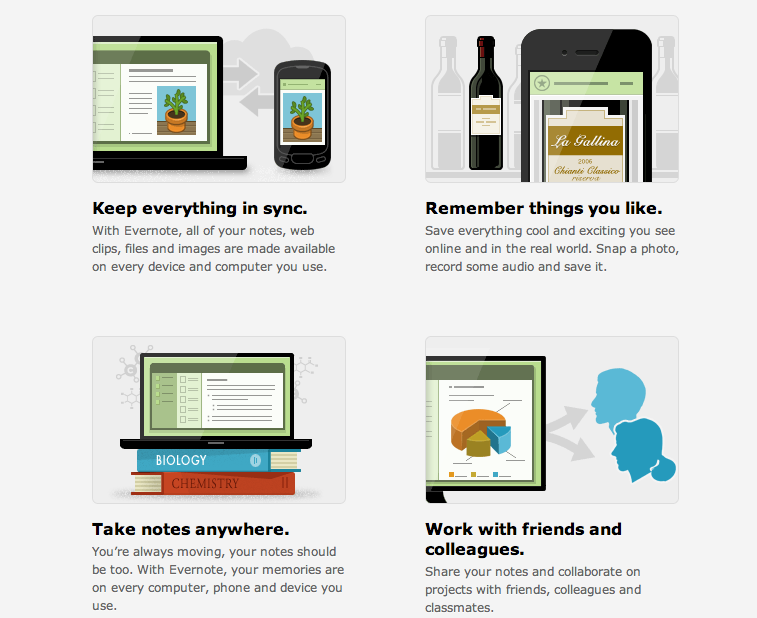
(Source: Evernote, www.evernote.com)
According to Walsh (2006, p.33), interpretation between readers and texts are a two-way interaction and thus, forms of which we interpret new texts can create new aspects of implications. In the field of design and publication, multimodal texts are currently turning into the regular patterns of society and therefore, our conceptual framework to understand them has to incorporate new ways of mode processing knowledge (Walsh 2006, p36).
References
  • Kress, G & Leeuwan, V 2006, Reading Images: The Grammar Of Visual Design, 2nd edn, Routledge, New York.
  • Walsh, M 2006, The 'textual shift': Examining the reading process with print, visual and multimodal text, Australian Journal of Language and Literacy, p.33-36.
  • 2011, Take Note of Everything, Evernote, viewed 13 November, <http://www.evernote.com/about/learn_more/>.
  • 2011, THE WORLD AS A LEARNING ENVIRONMENT, University of Amsterdam, viewed 13 November 2011, <http://www.mobieleonderwijsdiensten.nl/attachments/1765201/World_as_learningenvironment.pdf>.


Thursday, 25 August 2011

New Forms of Media Publishing

As stated in my second blog post, the usage of blogging continues to explode in growth. As stated by Kress and van Leeuwen (2006, p.36), new understandings are brought about in the semiotical landscape due to the modernization, multiculturalism, technology and communication in media. Thus, the modes of social media will continue to expand. Day-by-day, new forms of communication mediums in the social network are emerging.


(Source: O’Neill, n.d., makeuseof.com)

In the words of micro-blogging, an example of a breakthrough platform would be Twitter. According to O’Neill (n.d.), Twitter represents a social platform that allows users to write and broadcast short messages to their followers.

Although it seems more like sending a mobile text, Twitter is known for its unique benefits to bloggers and the media. Firstly, it serves as a medium that provides news where many media outlets have their own authentic account which functions as an online newspaper. 


(Source: Twitter.com, 2011)

Secondly, bloggers are able to support their blogs by using Twitter’s website called ‘Twitter Feed’. By the use of this, bloggers are able to ‘tweet’ their posts automatically through Twitter where it serves as an efficient method of promoting their webpages (O’Neill, n.d.).

Lastly, Twitter also provides credible methods of clarification. Most organizations and brands use Twitter as a medium to communicate and interact with consumers. This certainly shows its benefits towards the industry of Public Relations.


(Source: Twitter.com, 2011)

According to Naughton (2006), the unique and multifaceted modes of the relationship between online media and traditional journalism will develop to be beneficial to each other. In such a fast-moving era we all live in, the effects of these two powerful mediums are already starting to complement each other. 


References

  • Kress, G & Leeuwan, V 2006, Reading Images: The Grammar Of Visual Design, Routledge, New York.
  • O’Neill, M n.d., The Complete Guide to Twitter, Makeuseof.com, viewed 24 August 2011, <http://docs.google.com/viewer?a=v&q=cache:kf9YILoM5r4J:manuals.makeuseof.com.s3.amazonaws.com/twitter-guide.pdf+twitter+pdf&hl=en&gl=my&pid=bl&srcid=ADGEESiMKa92dpj5vnBDHl43ercpzos_Lva6g2ULzogBnMpPzUHWSPTCGELT04Rj_oxIRusOs8hiXyHNAbwyySysV20X2w_mPCpcx2BJnU-CBaUjfJSJ0J7EN5rJoP6F8DYWRdrALwfL&sig=AHIEtbSAWRW15Rf9sxJBsf0LE5O_gKfg1g>.
  • Jantsch, J 2009, Using Twitter for Business, Duct Tape Marketing, viewed 24 August 2011, <http://www.johnjantsch.com/TwitterforBusiness.pdf>.
  • Naughton, J 2006, Blogging and the emerging media ecosystem, Reuters Institute, viewed 24 August 2011, <http://reutersinstitute.politics.ox.ac.uk/fileadmin/documents/discussion/blogging.pdf>.